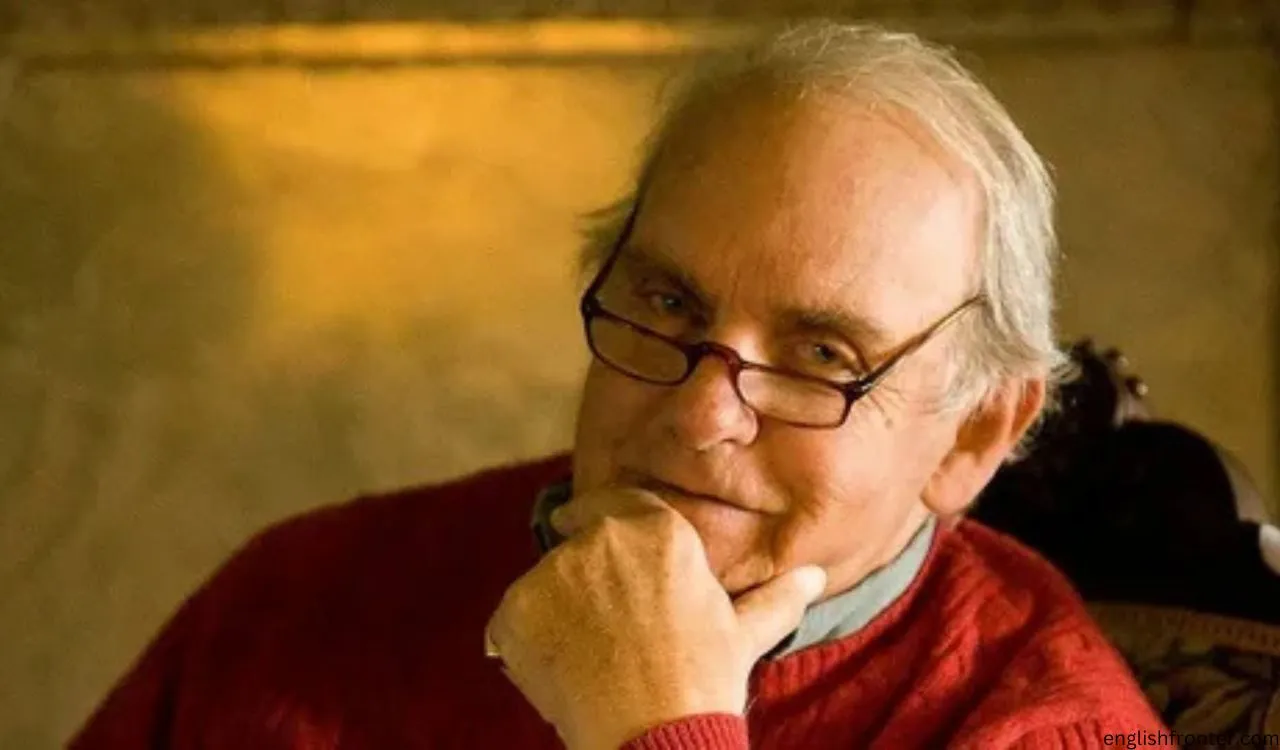
Frederick Buechner quotes are a powerful blend of spiritual depth, personal reflection, and literary beauty. His words explore the complexities of faith, love, and human experience, offering both insight and comfort.
Through his thought-provoking quotes, Buechner invites readers to engage with life’s profound mysteries.
Qrederick Buechner Quotes
Qrederick Buechner Quotes are very interesting and meaningful, let us look at some Qrederick Buechner quotes;
Quote 1
“To say that I was born again, to use that traditional phrase, is to say too much because I remained in most ways as self-centered and squeamish after the fact as I was before, and God knows remain so still. And in another way to say that I was born again is to say too little because there have been more than a few such moments since, times when from beyond time something too precious to tell has glinted in the dusk, always just out of reach, like fireflies.”
— The Sacred Journey: A Memoir of Early Days
Explanation:
Buechner reflects on the process of spiritual transformation, noting that while change may not always be immediately apparent, there are fleeting moments of transcendence that offer a glimpse into something greater, even if they’re hard to capture.
Quote 2
“The Kingdom of God is where we belong. It is home, and whether we realize it or not, I think we are all of us homesick for it.”
— Secrets in the Dark: A Life in Sermons
Explanation:
Buechner suggests that the Kingdom of God is our true home, and deep down, all humans yearn for that sense of belonging, even if they don’t consciously recognize it.
Quote 3
“And then the ultimate word of judgment that the master speaks is, ‘From him who has not, even what he has will be taken away.’ This from, you must remember, the Prince of Peace, the Good Shepherd. From him who has not, even what he has will be taken. That seems the ultimate injustice, to take away the one talent from a man who has only one talent and give it to the other ones. I take that to mean, again, not a punishment so much as the inevitable consequence of burying your life. If you bury your life—if you don’t face, among other things, your pain—your life shrinks. It is in a way diminished. It is in a way taken away.”
— A Crazy, Holy Grace: The Healing Power of Pain and Memory
Explanation:
Buechner interprets a biblical parable as a warning that when we avoid confronting life and our struggles, our existence becomes smaller and less meaningful. Failing to engage fully with life leads to loss.
Quote 4
“Our own happiness, our own peace, can never be complete until we find some way of sharing it with people who the way things are now have no happiness and know no peace. Jesus calls us to show this truth forth, live this truth forth. Be the light of the world, he says. Where there are dark places, be the light especially there. Be the salt of the earth. Bring out the true flavor of what it is to be alive truly. Be truly alive. Be life-givers to others. That is what Jesus tells the disciples to be. That is what Jesus tells his Church, tells us, to be and do.”
— Listening to Your Life: Daily Meditations with Frederick Buechner
Explanation:
Buechner emphasizes that true peace and happiness come not from self-centeredness but by actively helping others find joy and light in their lives, echoing the teachings of Jesus.
Quote 5
“The most precious thing I have to tell you about is the sadness. You don’t have to talk about pain, but you have to live out of your pain. Speak out of your depths. Speak out of who you truly are.”
— A Crazy, Holy Grace: The Healing Power of Pain and Memory
Explanation:
Buechner highlights that acknowledging and embracing our pain is crucial for genuine living. Our deepest truths often emerge when we allow ourselves to be vulnerable.
Quote 6
“But when melody wells up in thrushes’ throats, and bees buzz honeysong, and rock and river clap like hands in summer sun, then misery’s drowned in minstrelsy, and Godric’s glad in spite of all. Yet sometimes too he’s sad in spite of all, God knows, for there are other voices than the poor’s.”
— Godric
Explanation:
Here, Buechner reflects on the coexistence of joy and sorrow. Even in moments of beauty and gladness, there remains an underlying sadness that is part of the human condition.
Quote 7
“Maybe the most sacred function of memory is just that: to render the distinction between past, present, and future ultimately meaningless; to enable us at some level of our being to inhabit that same eternity which it is said that God himself inhabits.”
— Telling Secrets
Explanation:
Buechner proposes that memory has the power to transcend time, connecting us to an eternal reality that is beyond the limitations of past, present, and future.
Quote 8
“What can we do that makes us gladdest, what can we do that leaves us with the strongest sense of sailing true north and of peace, which is much of what gladness is? Is it making things with our hands out of wood or stone or paint on canvas? Or is it making something we hope like truth out of words? Or is it making people laugh or weep in a way that cleanses their spirit?”
— Secrets in the Dark: A Life in Sermons
Explanation:
Buechner asks what brings us true joy and fulfillment, suggesting that whether through creating or connecting with others, it’s the pursuit of what aligns us with our deeper sense of purpose that brings peace.
Quote 9
“The decisive war is the other one – to become fully human, which means to become compassionate, honest, brave. And this is a war against the darkness which no man fights alone.”
— The Magnificent Defeat
Explanation:
Buechner speaks of the internal struggle to become a whole, authentic person, emphasizing that this battle requires both courage and support from others.

Quote 10
“If I can’t see you for some reason but can only hear you, you don’t exist for me in space, which is where seeing happens, but in time, which is where hearing happens. Your words follow one after the other the way tock follows tick. When I have only the sound of you to go by, I don’t experience you as an object the way I would if you stood before me—something that I can walk around, inspect from all angles, more or less define.”
— Beyond Words: Daily Readings in the ABC’s of Faith
Explanation:
Buechner explores the profound connection of hearing, where listening to someone’s voice, unlike seeing, draws us into a more intimate experience, allowing us to understand them deeply, beyond physicality.
Quote 11
“It is not objective proof of God’s existence that we want but, whether we use religious language for it or not, the experience of God’s presence.”
— Secrets in the Dark: A Life in Sermons
Explanation:
Rather than needing logical evidence for God, Buechner emphasizes that the true longing is to experience the presence of the divine in our lives.
Quote 12
“I think that I learned something about how even tragedy can be a means of grace that I might never have come to any other way.”
— Telling Secrets
Explanation:
Buechner reflects on the idea that tragedy can lead to profound grace, showing how suffering can open the door to spiritual growth and understanding.
Quote 13
“It will be no ordinary birth but a virgin birth because the birth of righteousness and love in this stern world is always a virgin birth. It is never men nor the nations of men nor all the power and wisdom of men that bring it forth but always God.”
— The Magnificent Defeat
Explanation:
Buechner compares the birth of love and righteousness to a virgin birth, highlighting that these qualities are gifts from God, not human efforts or wisdom.
Quote 14
“We are in constant danger of being not actors in the drama of our own lives but reactors.”
— The Longing for Home: Reflections at Midlife
Explanation:
Buechner warns against living passively, reacting to life instead of actively shaping our own stories and decisions.
Quote 15
“What deadens us most to God’s presence within us, I think, is the inner dialogue that we are continuously engaged in with ourselves, the endless chatter of human thought.”
— Telling Secrets
Explanation:
Buechner suggests that our constant mental chatter distracts us from connecting with the divine, and silence is essential for spiritual peace.
Quote 16
“I do not believe that such groups as these… are perfect any more than anything human is perfect, but I believe that the Church has an enormous amount to learn from them.”
— Listening to Your Life: Daily Meditations with Frederick Buechner
Explanation:
Buechner contrasts traditional church structures with informal groups like Alcoholics Anonymous, noting how they often embody more of the core principles of faith.
Quote 17
“I’ve been a good steward of my pain.”
— A Crazy, Holy Grace: The Healing Power of Pain and Memory
Explanation:
Buechner reflects on the idea of managing one’s pain, viewing it as an opportunity for personal growth and spiritual development, rather than something to be avoided.
Quote 18
“There is no event so commonplace but that God is present within it, always hiddenly, always leaving you room to recognize him or not to recognize him, but all the more fascinatingly because of that, all the more compellingly and hauntingly.”
— Now and Then: A Memoir of Vocation
Explanation:
Buechner believes that God is present in every moment, even in the most mundane events, but it’s up to us to recognize that presence.
Quote 19
“This other war is the war to become a human being. This is the goal that we are really after and that God is really after.”
— Listening to Your Life: Daily Meditations with Frederick Buechner
Explanation:
Buechner speaks about the inner struggle to become truly human, encompassing qualities like compassion and honesty, and viewing it as a divine goal.
Quote 20
“Do it till the cows come home.”
— Listening to Your Life: Daily Meditations with Frederick Buechner
Explanation:
This whimsical phrase conveys the persistence and dedication that a prophet must have in spreading truth, even when the task seems unending.
Quote 21
“Where was time for holiness? What strength was left for faith? Let monks and nuns and priests have care of that.”
— Godric
Explanation:
Buechner reflects on how the demands of everyday life often overshadow the pursuit of holiness and faith, something often left to those in religious vocations.
Quote 22
“The story of Christ is where we all started from.”
— Listening to Your Life: Daily Meditations with Frederick Buechner
Explanation:
Buechner suggests that Christ’s story is foundational for all of us, and though we move beyond it, it remains a pivotal moment in our lives.
Quote 23
“Life without death has become as unthinkable to me as day without night or waking without sleep.”
— Listening to Your Life: Daily Meditations with Frederick Buechner
Explanation:
Buechner reflects on the inevitability and interdependence of life and death, emphasizing their inseparable nature.
Quote 24
“It seems to me almost before the Bible says anything else, it is saying that—how important it is to be alive and to pay attention to being alive.”
— The Remarkable Ordinary: How to Stop, Look, and Listen to Life
Explanation:
Buechner argues that the Bible’s first message is to truly live and pay attention to the richness of life that surrounds us.
Quote 25
“Faithful, as if their goodness is their faithfulness. They somehow have faith in him that somehow all will be well.”
— A Crazy, Holy Grace: The Healing Power of Pain and Memory
Explanation:
Buechner reflects on the connection between faith and goodness, suggesting that faithfulness is a choice to trust in God’s ultimate goodness, even when life is difficult.
Quote 26
“Because it is precisely through these stories in all their particularity, as I have long believed and often said, that God makes himself known.”
— Telling Secrets
Explanation:
Buechner emphasizes that God reveals Himself through the stories of our lives, in the unique and personal details that shape who we are.
Quote 27
“I loved him because I couldn’t help myself.”
— A Room Called Remember: Uncollected Pieces
Explanation:
Buechner speaks to the profound and transformative nature of love, which transcends our will and becomes an essential part of our existence.
Quote 28
“Praise someone or something for it would be so great that you might even have to go out and speak of it to the birds of the air.”
— Listening to Your Life: Daily Meditations with Frederick Buechner
Explanation:
Buechner suggests that the need to express gratitude for the goodness in life would be so overwhelming that it would compel us to share it with the world.
Quote 29
“The sadness was I’d lost a father I had never fully found.”
— Telling Secrets
Explanation:
Buechner speaks of the pain of losing a father whom he could never fully know, a sentiment of longing and unresolved loss.
Quote 30
“Podes despedir-te da tua família e dos teus amigos e afastar-te milhares de quilómetros…”
— Telling the Truth: The Gospel as Tragedy, Comedy, and Fairy Tale
Explanation:
Buechner explores the complexity of leaving home, both physically and emotionally, as we carry our loved ones with us even across great distances.
Quote 31
“Words spoken in deep love or deep hate set things in motion within the human heart that can never be reversed.”
— Secrets in the Dark: A Life in Sermons
Explanation:
Buechner reflects on the profound impact words can have, especially when spoken from strong emotions, shaping hearts and relationships in irreversible ways.
Quote 32
“We are commanded to love our neighbors as ourselves, and I believe that to love ourselves means to extend to those various selves that we have been along the way the same degree of compassion and concern that we would extend to anyone else.”
— Telling Secrets
Explanation:
Loving ourselves, according to Buechner, involves showing the same compassion to all versions of ourselves over time as we would to others, acknowledging our personal growth and struggles.
Quote 33
“If love is a matter of holding fast to, and identifying with, and suffering for, the ones we love, it is a matter also of standing back from, of leaving space for, of letting go of.”
— Now and Then: A Memoir of Vocation
Explanation:
Buechner speaks to the balance required in love: the closeness of suffering and sacrifice, paired with the necessary distance for personal freedom and growth.
Quote 34
“I never took it for granted that they believed any of even the most basic affirmations of the Christian faith concerning such matters as God and Jesus, sin and salvation, but always tried to speak to their skepticism and to honor their doubts.”
— Secrets in the Dark: A Life in Sermons
Explanation:
Buechner acknowledges the importance of respecting others’ doubts and skepticism, emphasizing honesty and openness in sharing faith without imposing it.
Quote 35
“It is also only during the last few years that I have begun to discover something about what watching and listening involve. I am talking about prayer… prayer as being deeply silent, as watching and listening for God to speak.”
— Telling Secrets
Explanation:
Buechner emphasizes the importance of silence in prayer, believing that God speaks through quiet moments and personal reflection, beyond words and events.
Quote 36
“When my daughter was dying, in effect, in this hospital on the west coast… I had this overpowering kind of comfort. God was silent. He said nothing I could hear; he did nothing I could see. But I had this tremendous sense that he was doing all he could do without blowing the whole show sky-high.”
— A Crazy, Holy Grace: The Healing Power of Pain and Memory
Explanation:
In a time of deep personal loss, Buechner speaks of experiencing God’s presence in silence and restraint, providing comfort even in the absence of clear answers.
Quote 37
“We try to fend off this world we yearn for where men live together as brothers because there is something in each of us that wants to live not for his brother but for himself.”
— The Magnificent Defeat
Explanation:
Buechner acknowledges the human tendency to live selfishly, which prevents us from embracing the true, selfless community that we crave but fear because of its demands.
Quote 38
“In fact I am inclined to believe that God’s chief purpose in giving us memory is to enable us to go back in time so that if we didn’t play those roles right the first time round, we can still have another go at it now.”
— Telling Secrets
Explanation:
Buechner suggests that memory is a tool for personal growth, offering us the opportunity to revisit past mistakes and grow from them, even if we can’t undo them.
Quote 39
“I don’t know what it means to love God. Really, I’m not all that good at it. But I think one of the things it means is, just as in the case of loving anybody else, you stop and watch and wait. Listen for God.”
— The Remarkable Ordinary: How to Stop, Look, and Listen to Life
Explanation:
Buechner believes that loving God involves attentiveness and openness, being present to listen for God’s subtle presence in our lives.
Quote 40
“Eternity is not endless time or the opposite of time. It is the essence of time.”
— Beyond Words: Daily Readings in the ABC’s of Faith
Explanation:
Buechner redefines eternity, suggesting that it’s not a stretch of time but a timeless essence that encapsulates all moments—past, present, and future.
Quote 41
“If the truth is worth telling, it is worth making a fool of yourself to tell.”
— Telling the Truth: The Gospel as Tragedy, Comedy, and Fairy Tale
Explanation:
Buechner highlights the courage required to speak truth, even when it means risking embarrassment or ridicule.
Quote 42
“Your father lies beneath a stone,’ old Aedwen mumbles, dozing at her wheel, and Godric thinks how it’s a stone as well they’re all beneath. The stone is need and hurt and gall and tongue-tied longing, for that’s the stone that kinship always bears, yet the loss of it would press more grievous still.”
— Godric
Explanation:
Buechner reflects on the burden of kinship and the emotional weight of family ties, where both the presence and absence of those bonds have deep consequences.
Quote 43
“I have spent uncounted hours of my life in such haggard waiting… It has taken me years to understand that what I feared most of all was perhaps less the disaster that might have befallen them than the disaster of being locked up in the dark of my own fear.”
— Telling Secrets
Explanation:
Buechner shares the emotional turmoil of fearing the worst for loved ones, only to realize that the true prison was his own fear and inability to move beyond it.
Quote 44
“Sloth is getting through life on automatic pilot. Not really being alive. Not really making use of what happens to you. Burying what you might have made something out of.”
— A Crazy, Holy Grace: The Healing Power of Pain and Memory
Explanation:
Buechner critiques a life lived passively, where one avoids the challenges and growth opportunities that come with embracing pain and joy fully.
Quote 45
“Christ never promises peace in the sense of no more struggle and suffering. Instead, he helps us to struggle and suffer as he did, in love for one another.”
— The Magnificent Defeat
Explanation:
Buechner reminds us that peace in Christ doesn’t mean the absence of suffering, but rather the ability to endure suffering with love and compassion.
Quote 46
“When they are sad and hurtful secrets… we can honor the hurt by letting ourselves feel it as we never let ourselves feel it before.”
— Telling Secrets
Explanation:
Buechner emphasizes the importance of confronting and processing pain and loss, honoring it by truly feeling it and allowing ourselves to heal.
Quote 47
“But it was something else too, MacFarlane said. It was a denial, but it was also the truth.”
— Telling Secrets
Explanation:
Buechner explores the complexity of truth, where even in our denial of the full truth, there are aspects of it that we cannot escape or avoid.
Quote 48
“The love of God. The mercy of God. The judgment of God. You take the shoes off your feet and stand as you would before a mountain or at the edge of the sea.”
— Listening to Your Life: Daily Meditations with Frederick Buechner
Explanation:
Buechner compares the awe-inspiring qualities of God’s love, mercy, and judgment to the experience of standing before something vast and powerful, like nature itself.
Quote 49
“I would go so far as to say that it may even have caused him to think the more highly of them because their unbelief grew from a far more honest view of the wretchedness of things than the belief of the devout.”
— On the Road with the Archangel
Explanation:
Buechner suggests that unbelief, born from honest struggle and doubt, can be more profound than belief that ignores the harsh realities of life.
Quote 50
“Another way, I think, is to be somehow trapped by your pain. Being stopped in your tracks. Never, in a sense, being able to escape your pain.”
— A Crazy, Holy Grace: The Healing Power of Pain and Memory
Explanation:
Buechner uses the example of Miss Havisham to illustrate how people can become trapped in their pain, unable to move forward or heal, choosing to relive their suffering.
Quote 51
“If you want to be holy, be kind.”
— Frederick Buechner
Explanation:
Buechner simplifies holiness to an act of kindness, suggesting that living a holy life is rooted in showing compassion and care for others.
Quote 52
“Glory is to God what style is to an artist. Glory is what God looks like when, for the time being, all you have to look at Him with is a pair of eyes.”
— Beyond Words: Daily Readings in the ABC’s of Faith
Explanation:
Buechner compares God’s glory to the style of an artist, suggesting that while we can’t fully comprehend God, we can experience glimpses of His glory through our own limited perspective.
Quote 53
“Lying to God is like sawing the branch you’re sitting on. The better you do it, the harder you fall.”
— Peculiar Treasures
Explanation:
Buechner warns against dishonesty, comparing it to sawing the branch we sit on—ultimately, lying only leads to greater consequences.
Quote 54
“Somos todos mais místicos do que acreditamos ou queremos crer… Seguir em frente ciente de que algo aconteceu, apesar de não ter certeza do que foi, é entrar na dimensão da vida de que trata a palavra religião.”
— A Room Called Remember: Uncollected Pieces
Explanation:
Buechner reflects on the mystical nature of life and how moments of uncertainty and wonder, even without full understanding, are part of the spiritual journey.
Quote 55
“I believe without the miracles I have prayed for then… I believe because certain, uncertain things have happened, dim half-miracles, sermons and silences and what not.”
— Frederick Buechner
Explanation:
Buechner speaks to the miracles of life that don’t always meet expectations but still affirm faith through subtle, quiet moments of grace.
Quote 56
“During one of our sessions… I was simply not ready to hear it yet.”
— Telling Secrets
Explanation:
Buechner shares his experience of not being ready to receive profound insights or healing, highlighting how timing and readiness affect our personal growth.
Quote 57
“Unbelief is as much of a choice as belief is.”
— Listening to Your Life: Daily Meditations with Frederick Buechner
Explanation:
Buechner points out that choosing not to believe is just as intentional as choosing to believe, underlining the active nature of both positions.
Quote 58
“We cannot make ourselves known to each other; we are not healed and forgiven by each other’s presence.”
— The Alphabet of Grace
Explanation:
Buechner emphasizes the limitations of human connection, where true healing and understanding come from a deeper, divine presence rather than from mere human interaction.
Quote 59
“If it please you, the lady’s name again?” says Reginald. His quill is poised. If God had come to Reginald and not to Moses in the burning bush, he would have asked him how to spell the great I AM so he’d be sure he had it right.”
— Frederick Buechner
Explanation:
Buechner uses humor to reflect on the complexities of language and understanding, imagining a more trivial, human approach to divine revelation.
Quote 60
“A glutton is one who raids the icebox for a cure for spiritual malnutrition.”
— Listening to Your Life: Daily Meditations with Frederick Buechner
Explanation:
Buechner uses the metaphor of gluttony to illustrate how we sometimes seek superficial comfort or distractions to address deeper, spiritual needs.
Writing Style of Frederick Buechner
Frederick Buechner’s writing style is deeply reflective and poetic, blending profound theological insights with personal vulnerability.
His storytelling is rich with vivid anecdotes and human experiences, inviting readers into an intimate conversation about faith, doubt, and life’s complexities.
Buechner’s prose is often philosophical, engaging with existential questions and the mysteries of God while maintaining a lyrical quality that resonates emotionally.
He balances honesty with humor, offering readers both depth and levity, and frequently uses metaphors to convey spiritual truths in a relatable way.
His work is not only theologically rich but accessible, drawing from personal experiences and literature to create a nuanced exploration of human existence and divine grace.
Conclusion
Frederick Buechner quotes offer profound insights into the human condition, blending spiritual depth with personal vulnerability.
His writing invites readers to reflect on life’s complexities, faith, and the mysteries of God through poetic and intimate language.
With a balance of humor, honesty, and theological richness, Buechner’s work resonates deeply and encourages spiritual growth. In a similar spirit, Hudson Taylor quotes echo a life of radical faith and surrender, reminding readers that belief is not only something to be understood, but something to be lived.
FAQ’s
Buechner encourages us to pay attention to the moments, events, and people in our lives, recognizing that they carry deep meaning and divine purpose.
Buechner describes “the place God calls you” as the intersection of your deepest desires and the world’s deepest needs.
This quote highlights the lasting impact of relationships and experiences.
Buechner’s quote invites us to embrace the world around us in all its complexity, beauty, and struggle.