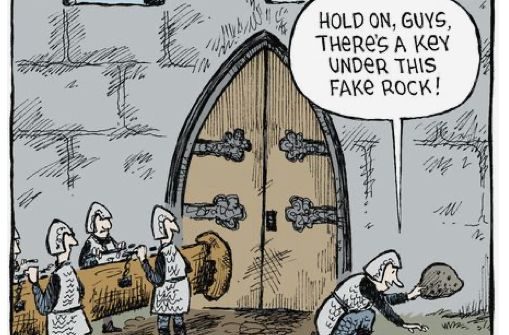
Comic irony is when things happen in a funny or unexpected way, making us laugh. There are different types, like when someone says something, but means the opposite.

What Is Comic Irony?
Comic irony is a literary trope in which there is a comic or ludicrous conclusion as a result of a difference between what is expected to happen and what actually happens.
Misunderstandings, false identities, or surprising turns that elicit laughter are frequently involved. This type of irony gives stories more nuance and humor by highlighting the peculiarities of human nature or ridiculing social mores.
Historic Comic Irony
Historical comic irony occurs when real-life events take amusing and surprising turns. For example, the Australian government attempted to deploy machine guns to control emu numbers that were ruining fields during the Great Emu War of 1932, but the plan comically backfired.
The Dancing Plague in Strasbourg in 1518, where hundreds of individuals danced uncontrollably in the streets for weeks on end, was another strange incident.
A massive molasses tank in Boston ruptured in 1919, unleashing a swift flood of molasses that caused property damage and fatalities. It was an ironic calamity.
An ironic mishap marred the 1959 St. Lawrence Seaway inauguration when the champagne bottle failed to shatter.
The Football War between Honduras and El Salvador in 1969 began with a soccer match, combining irony and humor in a series of unexpected and often amusing events.
Example Of Comic Irony From Literature
Oedipus Rex
Sophocles’ “Oedipus Rex” is essentially a tragic drama, but within the larger framework of the story, there is a historical humorous ironic aspect.
The prophecy given to King Laius and Queen Jocasta, the parents of Oedipus, is one instance.
Their boy will grow up to kill his father and wed his mother, according to the prophecy. They choose to leave their young boy behind in an effort to escape this fate.
But Oedipus makes it through, and he’s eventually taken in by another royal family without knowing his real ancestry.
The parents’ actions had unexpected repercussions, which adds to the comedic irony. Rather than hindering the prophecy, they inadvertently initiate the sequence of circumstances that culminate in its realization.
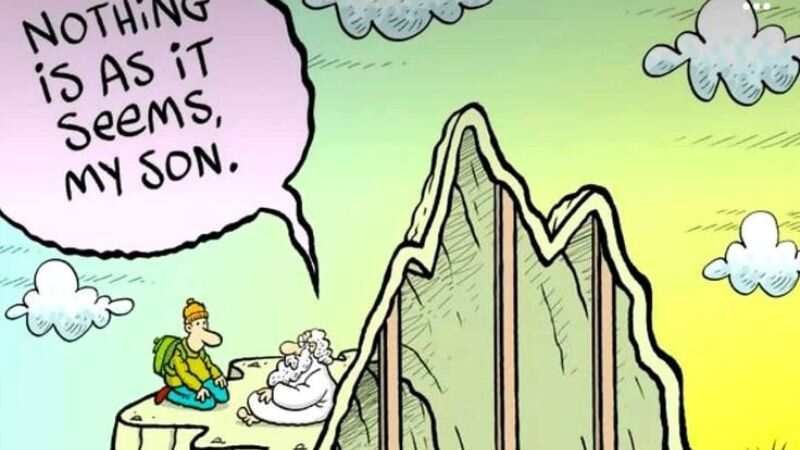
Ironically, they help their fate come to pass by attempting to avoid it. This turn of events highlights the intricacy and inevitable nature of fate in the play’s plot while also lending a degree of irony to the tragic tragedy.
“Romeo and Juliet” by William Shakespeare
Romeo believes Juliet is dead in this tragedy, and he swallows poison to die with her. But when Juliet discovers Romeo is dead when she wakes up, she ends her own life.
By emphasizing the idea of fate and the results of rash decisions, the irony heightens the play’s tragic quality.
“The Importance of Being Earnest” by Oscar Wilde
The play is full of ironic moments. To escape his boring rural life, Jack, for instance, creates a brother named Ernest.
But as it happens, he is actually Ernest, and Algernon, his friend, is posing as Ernest to court Jack’s ward. It’s by leading to a hilarious miscommunication. The sarcasm here parodies Victorian social mores and the value of outward looks.
“Pride and Prejudice” by Jane Austen
Irony abounds in the book, especially in the interactions between Elizabeth Bennet and Mr. Darcy.
The famous first line of Jane Austen’s Pride and Prejudice, which highlights Victorian the norms of society reads, “It is a truth universally acknowledged, that a single man in possession of a good fortune, must be in want of a wife.”
In spite of this, a large portion of the narrative revolves around Mr. Darcy, a wealthy man who at first shows no interest in wedlock with Elizabeth Bennet.
But as the story progresses, Elizabeth’s prejudice and Darcy’s pride are both called into question, casting doubt on their presumptions about character, love, and status.
Austen deftly exposes the stresses of marriage and position through irony and social satire, showing that genuine attachment develops from respect and understanding between people rather than from material wealth or social prestige.
This irony questions the social mores of the day, which frequently dictated a person’s destiny based on their initial impressions.
“Twelfth Night” by William Shakespeare
There’s a classic case of mistaken identity in this comedy. After taking on the identity of Cesario, Viola falls in love with Duke Orsino.
But Orsino is in love with Olivia, who falls in love with Cesario (Viola), setting up a comical triangle of love based on misidentification. The irony emphasizes the complexity of gender roles and love, giving the
Types Of Comic Irony
| Type of Irony | Definition | Example |
| Verbal Irony | When a character says something but means the opposite, creating humor from the audience’s awareness of the real meaning. | Character caught in the rain saying, “What a beautiful day!” |
| Situational Irony | Involves a situation where there’s a difference between what’s expected to happen and what actually occurs, often leading to humor. | A fire station burning down, presenting an unexpected and ironic situation. |
| Dramatic Irony | Arises when the audience knows information that the characters don’t, creating tension and humor as the characters remain unaware of the true situation. | In a play, the audience is aware of a character’s surprise birthday party, but the character thinks everyone has forgotten. |
| Structural Irony | Occurs when the structure of the story itself is ironic, resulting in comedic effects. | A detective story where the investigator turns out to be the perpetrator, adding an ironic twist to the narrative. |
| Cosmic Irony | Involves situations where fate or the universe seems to play a joke on characters, creating a sense of absurdity. | Saving up to buy an umbrella to avoid rain, but the umbrella shop is destroyed in a flood, creating an ironic outcome. |
| Historical Irony | Relates to irony within historical events or narratives, often featuring unexpected outcomes or twists. | A well-known peace promoter accidentally sparking a war, showcasing an unexpected historical irony. |
| Socratic Irony | Named after Socrates, it involves feigned ignorance to expose flaws in someone else’s argument. | A teacher pretending not to understand a simple math problem to encourage a student to think critically. |
Conclusion
In a nutshell, comic irony is like a funny surprise in stories or real life that makes us laugh. It happens when things don’t go the way we expect or when someone says something, but it means the opposite.
For example, if a character in a story thinks they’re having a beautiful day while caught in the rain, that’s comic irony. It’s also when we know something in a story that the characters don’t, making it funny.
Whether it’s fate playing a joke, real history turning out unexpectedly amusing, or pretending not to know something for a reason. Comic irony makes things more fun and full of surprises.
FAQs
Comic irony is like a funny surprise, such as someone calling a rainy day “beautiful.
Cosmic irony’s effect is when fate plays a joke, like saving for an umbrella only for the shop to get flooded.
The true definition of irony is when things happen in a way that’s the opposite of what you expect.
Cosmics, might refer to cosmic-related topics, but without more context, it’s unclear.
Related Posts
Be Kinder Than Necessary | J.M. Barrie
Letter to My Daughter Quotes by Maya Angelou
Post Modernism | Definition, History, Characteristics & Post Modernists