One thing I have observed over the years when writing and reading content is that there are sentences that simply feel alive. Read them, and all of a sudden, you are not dealing with objects, ideas anymore; you know, you are dealing with movement, with feeling, and with a personality. This is precisely where personification examples come in, bringing words to life, creating an experience that the reader remembers.
The first time I learned about personification and the way it works, it made my writing change radically. Rather than telling things in a one-dimensional, dull manner, I began to give life to the wind, color to the sky, and sounds to nothingness. It is a little device, yet it carries so much force that it makes writing more interesting, more relatable, and easier to remember without complicating anything.
Whether you have ever had a hard time making your writing sound special or have ever wondered how some sentences seem to express themselves more than others, you will like this. I will also take you through the specifics of how personification works, and some simple and creative examples you can begin to use immediately.
What Is Personification In Simple Words
Personification is a literary tool in which things that are not human are assigned human attributes. These may be things, living beings, the natural world, or even an abstract concept such as time or feelings. It is a part of the wider group of figurative language, a feature that assists in producing lively imagery and sentiment in the text.
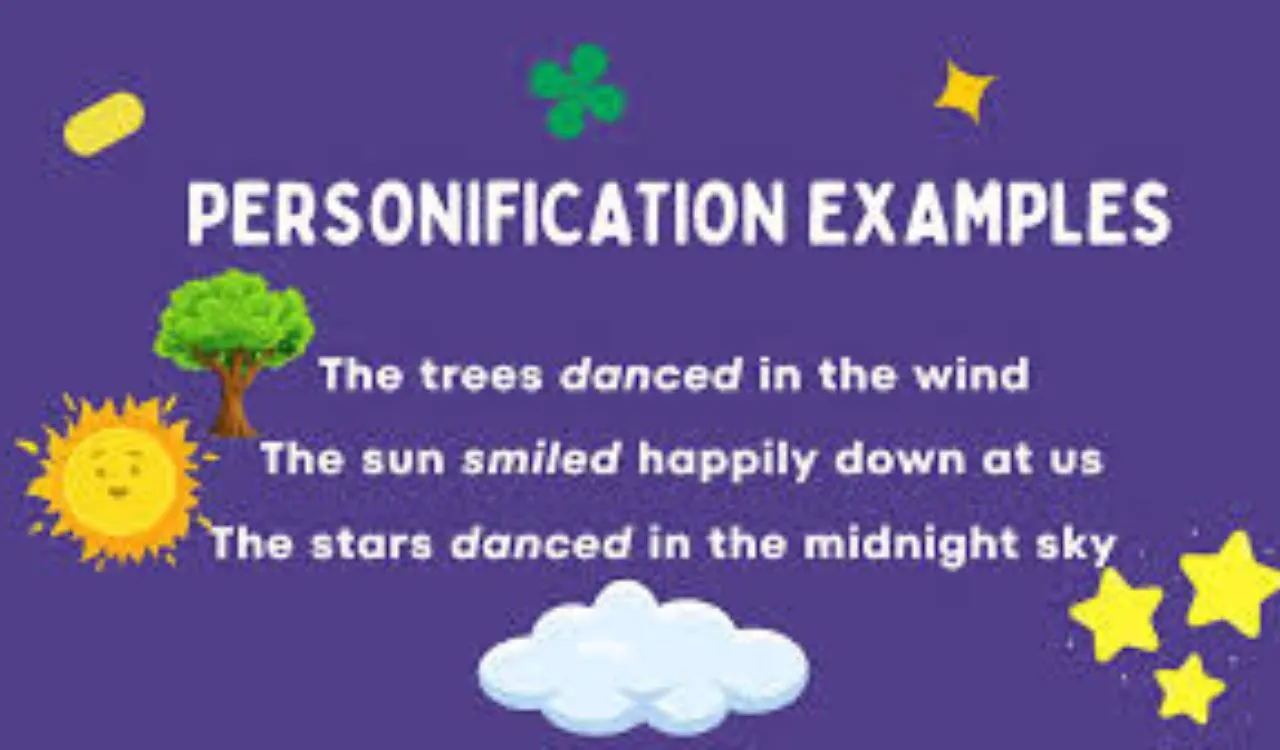
Personification enables a writer to make something dead come to life instead of describing it straightforwardly. We can use this as an example; the sun smiled down, making that not smileable look friendly. This renders the sentence more interesting and easier to visualize.
Personification is a technique used by writers to reach readers at a more intimate level. It renders the descriptions more personal and expressive. Starting with storytelling and poetry, and then on to general writing, this method assists in making simple concepts memorable and powerful without the involvement of complex words, much like how words of agreement make conversations smoother and more engaging.
The Purpose of Personification in a Sentence
Personification is not a vain style of writers, it has its purpose. In its essence, it assists in building better images. When things or concepts act as people, a reader can immediately imagine and experience what is going on.
The other cause is emotional attachment. The words the lonely road waited for travelers provide an added mood, something that cannot be accomplished by a simple sentence. It does not describe the scene but rather invites the reader into it.
Readability is also enhanced by use of personification. It does not make the process of simple descriptions dull, but rather entertains the reader. It can also render writing more convincing and relatable in blogs, stories, and even marketing content. In the right hands, it makes otherwise normal sentences seem like they come alive as the words are being spoken to the reader.
For example, if you enjoy playing with language creatively, you might also like exploring tools like a norse language translator, which can inspire unique sentence structures and storytelling styles. Personification makes common sentences well, almost like the words are speaking to the reader when it has been used properly.
Structured Table
| Section | Key Idea | Explanation | Example |
|---|---|---|---|
| Introduction | Writing feels alive | Personification adds emotion and movement to writing | “The wind whispered softly” |
| Definition | What is personification | Giving human traits to non-human things | “The sun smiled” |
| Purpose | Why writers use it | Improves imagery, emotion, and engagement | “The lonely road waited” |
| Basic Examples | Simple sentences | Easy sentences for beginners to understand | “The alarm screamed loudly” |
| Creative Usage | Advanced expression | Adds mood, depth, and storytelling power | “The rain begged to be let in” |
| Comparison | Personification vs others | Different from metaphor and simile | “Time is a thief” vs “Time flies” |
Personification Examples Sentences for Scrats
Theory is one thing and examples are another. Simple and straightforward personification sentences that demonstrate how the concept applies in practice are of greatest benefit to beginners.
- Some easy examples include:
- The trees rustled in the wind.
- The alarm clock did its screaming to wake him.
- The star-fancy danced above the night sky.
These are plain but effective sentences. They use commonplace things and attribute them with human behaviors. This assists in painting the picture in the minds of the readers.
Personification seems more common in our everyday lives than one might think. Sayings such as time flies or opportunity knocks are popular, said without much consideration. Mastering to identify and construct this type of sentence would help to write easily without coercing genius and complicating thoughts.
Examples of Personification: Creative Personification
After the fundamentals are properly understood, writing can turn expressive. Examples of creative personification take on more than a mere description and begin to create mood and image.
- Think of some examples, nature-based, such as:
- The rain came beating on the window with a request to come in.
- The sun spread the arms of gold across the horizon.
- Examples given in objects can also be alive:
- The ancient chair creaked with recollections.
- Each notification left the phone begging to be paid attention to.
- Even feelings have their personification:
- The fear made its way into his mind.
- Hope sighed that it would improve.
These are illustrations of how personification gives writing a personality. It turns simple descriptions into visuals that a reader can touch, visualize, and relate to on a more personal level.
Personification vs Metaphor vs Simile
Personification is commonly mixed up with metaphor and simile, though they are used to different effects. Knowing the distinction aids writers in making better use of them.
Personification makes the non-human things have human characteristics. And as an example, the wind howled in anger attributes action and emotion to the wind.
In metaphor, we compare two things directly, saying that one is the other. In an example, time is a thief implies that time didn’t steal moments explicitly, but used human traits.
Instead, a simile involves words such as as or like. Eg, the wind was as loud as a scream, is a comparison that does not objectify the object as a person.
This understanding of these differences enables writers to adopt the appropriate technique depending on what they wish to convey to make their writing more accurate and effective.
Practice Personification in Your Own Sentences
A basic method will help to learn how to write sentences of personification examples more easily. Identify an object, feeling, or thought first. Then imagine a human act or emotion that would be equal to it.
To illustrate, when the object is rain, an example human characteristic is some whistling or some knocking. Put them together in a sentence such as, the rain has been whispering on the roof.
Another thing that writers should pay attention to is to make it natural. Impersonated personification may be clumsy and distracting. Rather, align the mood being created with the tone of the sentence.
Making good use of everyday language is also a good tip. Numerous everyday phrases make use of personification. Through practice and trying various ideas, writers can create a natural flow that will make their sentences interesting without trying too hard.
Worst Things to do in Personification
Personification is a potent tool, but it can be overused and abused. An obvious error is to impose human attributes where they are inappropriate. To illustrate, attributing intricate feelings to everyday items may make writing seem like a foreign language.
The other is using excessive figurative language in sentences. With all lines being personifications, the writing process may prove overwhelming rather than involving. Balance is key.
This is also easily confused with other literary devices. Personification and metaphor are occasionally confused by writers and can make their writing less effective.
This is well illustrated in a mini real-life case. The pencil cried out in fear, wrote one student. Although imaginative, it was over the top and disorienting. It would be improved by a more natural but still providing personality; the pencil slipped nervously out of his hand.
Best Personification Advanced Personification
Personification may be employed in more advanced manners as writing skills increase. Sentences with advanced personification. The use of imagery, emotion, and narrative is often used together in advanced personification to produce more effect.
For instance:
- The city does not rest; it was always murmuring something in the ears of people.
- Time pursued him like a slave, and would not abate.
These are not just descriptive sentences, but build up atmosphere. They enable the reader to experience a tense, urgent, or peaceful state depending on the structure of the sentence.
Personification can also be combined with other techniques to add depth to writing. The key is subtlety. Advanced use does not imply difficult, but intentional. It can be so natural and easy when it is done correctly, and the writing is more immersive without the focus being on the technique itself.
Personification Can Make you a Better Writer
Personification is not merely a figure of style; it is also an effective way of enhancing the art of writing. It promotes creativity, forcing writers to see beyond the literal meaning and consider the imaginary possibilities in expressing ideas.
It also increases description. Writers are taught to demonstrate scenes and feelings instead of telling facts, and this makes contents more interesting. This proves particularly helpful in storytelling, blog writing, and even in marketing content, where emotional resonance is important.
The other advantage is that it is more engaging to the reader. Living sentences are more memorable. They produce a greater impact, and they hold the readers in suspense.
Eventually, writing personification teaches writers to find a personal voice. It brings character to their writing and makes it distinctive without resorting to the use of complex words and hackneyed ingenuity.
Uses and Abuses of Personification
It is as important to know when to use personification as it is to know how to use personification. It is most effective in imaginative writing, narratives, blogs, and descriptive material where interaction and imagery are vital.
But it might not necessarily be suitable for formal or technical writing. Too much figurative language in reports or academic papers can make them less clear and less professional. Where English is concerned, it is better to keep it simple.
Balance is the key factor. Several well-placed sentences of personification can make writing better, but excessive use of personification can be unnatural.
The writers must keep their audience and intent in mind. Personification can be used to great effect, should the aim be to reach the heart and paint pictures. When clarity and precision are most important, then they must be applied with caution, or they should be avoided at all costs.
Conclusion
There is a special way in which personification can transform writing. It brings regular sentences and breathes life, feeling, and character into them. Be it the wind whistling or the passage of time, these little tricks have a tremendous effect.
As a beginner, it begins with some basic examples. In the case of seasoned writers, it is used as a storytelling and more expressive tool. The trick is to make it natural, balanced, and purposeful.
Personification can be learnt by anyone with practice. It does not involve any complicated grammar or complex words; it only takes a little imagination and some observational skills. It is one of the simplest methods to make the process of writing more enjoyable and memorable once knowing it.
Frequently Asked Questions
What is an easy example of personification?
An easy one is that the sun smiled down on us. The sun cannot smile; however, to make the sentence feel warm and positive, it is given a human attribute.
What is the purpose of personification in a text?
It is employed to make writing more interesting and lively. Assigning human attributes to subjects or concepts, writers form a more vivid image and an emotional appeal to the audience.
What is personification? Is it a metaphor?
No, personification attributes human characteristics to things which are not human, whereas a metaphor simply directly compares two entities by saying that one is another.
Is it possible to use personification in formal writing?
It may be employed with discretion; however, it is better suited to creative or descriptive writing. Formality is often preferred over figurative language in a formal setting.
What can novices do to practice personification?
Novices can exercise by using common items and attributing simple human behaviors to them, and then converting the thoughts into brief sentences.