
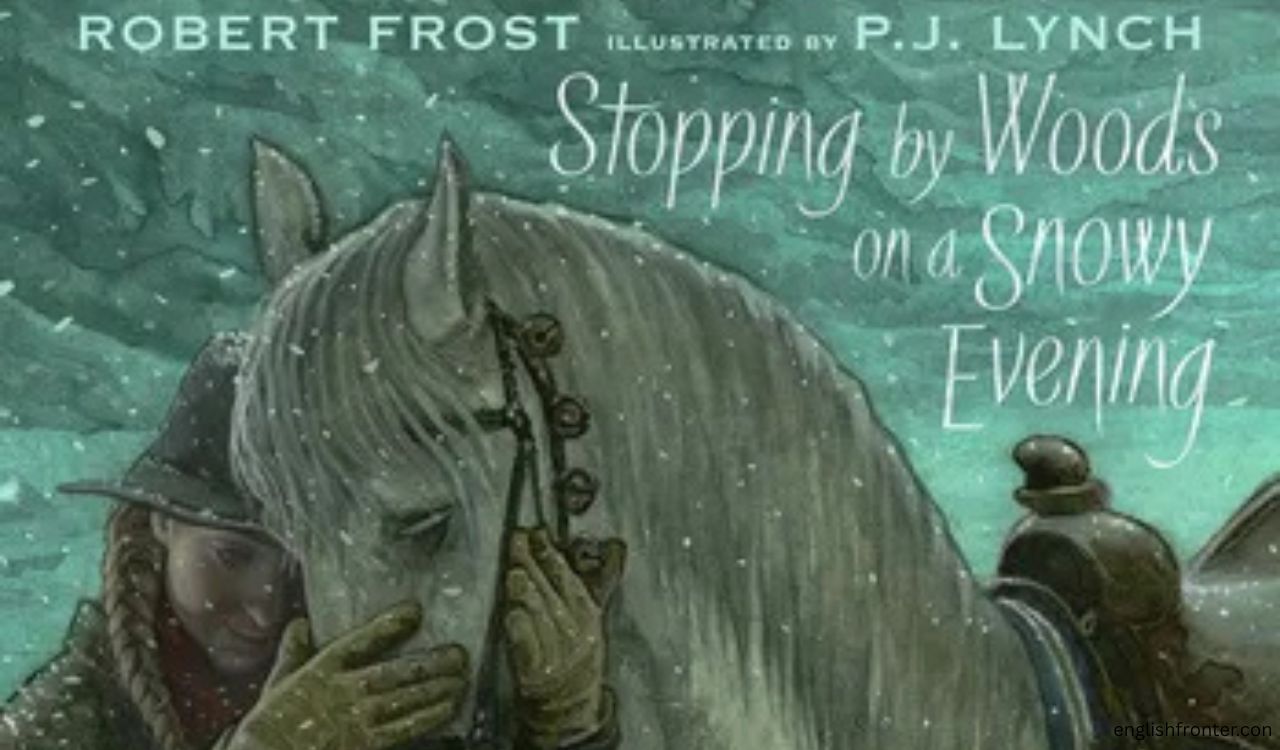

The Runaway by Robert Frost is a poignant exploration of nature, fear, and human responsibility through the lens of a fleeting encounter with a frightened colt in a snowy landscape.
Summary Of The Runaway by Robert Frost
In the first stanza, Robert Frost’s poem “The Runaway” opens with the speaker and another person finding a colt, a young horse, in a mountain pasture.
The colt is shown as agitated, with one foot propped up against a wall and frightened snorts coming from it. The colt darts off, taking the onlookers with it as the snow begins to fall.
In the second stanza, the colt’s retreat, described in the second stanza as “miniature thunder,” is audible as it gallops away amid the snowflakes falling.
The onlookers see the colt’s brief silhouette against the snowy background, appearing dull and grey despite the snow’s obscuring effect on visibility. They surmise that the colt’s apprehension of the snow is authentic.
Analysis Of The Runaway By Robert Frost Poem
The poem begins in a gentle manner but becomes more tense (pastoral-darker) when the snow drops. The tranquility of the setting is a contrast to the nervousness of the colt which creates tension between the serenity of nature and pure panic of an animal.
The personification of the colt by Frost provides readers with an emotional perspective of the experience of animals, their confusion is how we feel when we are faced by the change.
It is the repetition / anaphora which repeats the And and, by that repetition, movement and breath are imitated, and so is the restlessness of the anxious young colt running away continuously.
The environment, which Frost uses, and his vision are important: the spectators are not part of the action, they are in the wrong place and helplessly watch a horror unfold without knowing what to do.
This contrast between human knowledge and animal instinct is the emotional component of the poem.
Finally, the message to the missing caretaker, as we know it: “Should be told to come and take him in, makes the observation into silent judgment.
It involves not just a stray animal. Frost encourages a compassionate attitude toward all the living organisms through the fear and responsibility theme, which remains applicable in the world of 2025, full of climate anxiety and a lack of emotion.
In the third stanza, the spectators consider the colt’s trepidation, questioning whether even its mother could allay it by brushing off the snow as innocuous weather.
In addition, they express concern for the colt’s safety, wonder where its mother has disappeared, and worry that the colt will be left on its own in the wintry terrain.
The sound of the colt’s clattering hooves as it scales the wall again heralds its return in the final line. Its tail is held straight in an alarming manner, and its eyes convey a wide-eyed panic.
Observers comment on the carelessness of whoever left the colt outside in the bitter cold, pointing out its quivering coat.
Symbolism In The Runaway Robert Frost
| Symbol | Explanation |
|---|---|
| Snow | Symbolizes the natural world’s influence on animals and their responses to it, highlighting its power and the passage of time and change it brings. |
| Colt | Represents innocence, vulnerability, and the instinctual response to fear, serving as a mirror to human experiences of vulnerability and the need for protection. |
| Mother | Symbolizes protection and safety, embodying nurturing care and guidance, thereby accentuating the absence of these qualities for the colt and its vulnerability. |

Line To Line Explanation Of The Runaway
Once when the snow of the year was beginning to fall, We stopped by a mountain pasture to say, ‘Whose colt?’ A little Morgan had one forefoot on the wall, The other curled at his breast. He dipped his head And snorted at us. And then he had to bolt.
Explanation
The arrival of snow in the first verse of “The Runaway” creates a calm yet ominous atmosphere for the encounter with the colt.
The colt is described as being vulnerable and uneasy because of his position, with one foot on the wall and the other curled protectively.
Its apprehensive snorts and dropping of the head in response to the onlookers suggest an innate fear of the oncoming snowstorm.
The colt’s abrupt bolt, compared to “miniature thunder,” emphasizes how fiercely it is flying and how urgently it is afraid.
We heard the miniature thunder where he fled, And we saw him, or thought we saw him, dim and grey, Like a shadow against the curtain of falling flakes. ‘I think the little fellow’s afraid of the snow. He isn’t winter-broken. It isn’t play With the little fellow at all. He’s running away.
Explanation
The viewers’ blurry eyesight, reflecting the erratic and unpredictable quality of the natural world, is reflected in their attempt to follow the colt’s movements through the falling snow.
Moreover, there is a sense of mystery and transience to the little views they get of the colt’s figure, barely visible through the whirling flakes.
The colt’s character is given depth by the conjecture regarding its intentions and feelings; it is shown as more than just a helpless animal but as a sentient entity that is capable of anxiety and apprehension.
The skepticism expressed over the colt’s capacity to interpret the snow as benign weather emphasizes the disparity between human comprehension and animal intuition.
I doubt if even his mother could tell him, “Sakes, It’s only weather.” He’d think she didn’t know! Where is his mother? He can’t be out alone.’ And now he comes again with a clatter of stone And mounts the wall again with whited eyes And all his tail that isn’t hair up straight.
Explanation
The watchers’ worries about the colt’s well-being grow in this stanza as they consider how vulnerable it is in the severe winter climate.
In addition, questions concerning the lack of parental supervision and care are raised by the mention of the colt’s mother, which evokes concepts of protection and nurture.
Furthermore, the skepticism over the efficacy of the mother’s promise highlights the colt’s instinctual fear of the snow, which is not based on reason.
Moreover, in times of hardship, the colt’s isolation in the wintry surroundings serves as a moving reminder of the value of community and camaraderie.
He shudders his coat as if to throw off flies. ‘Whoever it is that leaves him out so late, When other creatures have gone to stall and bin, Ought to be told to come and take him in.’
Explanation
The colt returns to the wall in the final verse, clearly distressed, and the emphasis shifts back to its physical presence. There’s a sense of urgency and agitation to the clatter of its hooves hitting the stones, which reflects the tumult inside the colt’s own mind.
The viewers’ outrage at the careless colt’s owner shows their empathy, care, and awareness for the animal’s welfare. It also shows that they understand that it is their personal duty to speak up for the rights of weaker animals.
The poem’s underlying message of compassion and care for all living things is emphasized by the call to action.
Themes In The Runaway by Robert Frost
Nature and Weather
The relationship between animals and their natural surroundings, especially in reaction to weather occurrences like snow, is eloquently captured in Frost’s poem.
We see the colt’s natural response when the snow starts to fall, which illustrates its close relationship to the natural cycles of the seasons.
Frost uses this to remind us of our own role in the greater scheme of things and the significant influence that the natural world has on both humans and the animals who live around us.
Fear and Vulnerability
The central topic of “The Runaway” is vulnerability and anxiety. The colt is visibly afraid of the snow, which is a painful reminder of animals’ natural reactions to perceived threats.
The colt is depicted as weak in the face of nature’s powers despite its size and strength, underscoring the universal emotion of dread and the primal need for safety and protection.
Moreover, Frost asks us to consider our own worries and vulnerabilities in life’s journey and to sympathize with the vulnerability inherent in all living things through the colt’s predicament.
Care and Responsibility
The watchers’ worry for the colt’s welfare emphasizes the concepts of duty and kindness toward animals. They feel obligated to protect and look after the colt since they see how afraid and distressed it is.
Moreover, this subject reminds us of the value of compassion, empathy, and stewardship in our interactions with the natural world, which is in line with our larger ethical obligations to the creatures we share this planet with.
Furthermore, Frost’s poem is a subtle reminder of how we are all related to other living things and how our actions have a significant impact on the fragile balance of existence.
Figure of Speeches In The Runaway
| Figure of Speech | Example | Explanation |
|---|---|---|
| Personification | The colt is described as having human-like behaviors, such as fear and the desire to escape. | This figure of speech attributes human characteristics, emotions, or behaviors to non-human entities, in this case, the colt. |
| Simile | The colt is compared to a shadow against the falling snowflakes, emphasizing its fleeting and indistinct appearance. | A simile is a comparison using “like” or “as” to show similarities between two different things, here, the colt and a shadow. |
| Hyperbole | The observers exaggerate their concern for the colt’s safety by suggesting that whoever left it out in the snow should be informed to take it inside. | Hyperbole is an exaggeration used for emphasis or effect, in this case, to highlight the observers’ heightened concern for the colt’s well-being. |
Conclusion
In “The Runaway” by Robert Frost, the fleeting encounter with a frightened colt serves as a powerful reminder of our interconnectedness with nature and the importance of empathy and stewardship towards all living beings.
FAQs
The Runaway by Robert Frost explores nature’s power over animals and the responsibilities of caretakers.
The rhyme scheme of “The Runaway” by Robert Frost is irregular, generally following an ABABCDCD pattern.
Robert Frost’s poetry primarily explores human existence, nature, rural life, and the human condition.
Robert Frost was a celebrated American poet renowned for his rural imagery and colloquial speech.
The main theme of “The Runaway” by Robert Frost is the interaction between humans and animals in the natural world, emphasizing nature’s power, fear, vulnerability, and human responsibility.
Related Posts:
The Test Of A Man | Summary, Analysis & Figure Of Speeches
The Man In The Glass Poem| Summary, Analysis, Themes
Marxism In Literature| Definition, History & Famous Marxists
Oswald In King Lear | Character Analysis & Quotes
Analysis Of First Player’s Speech In Hamlet | By Shakespeare

