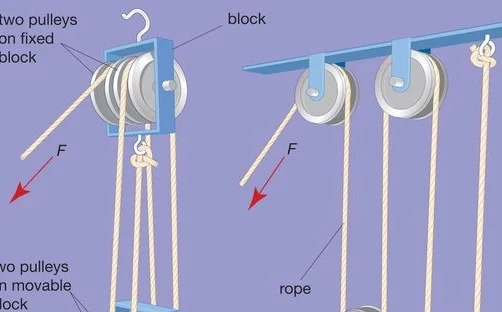
Pulleys are mechanical devices consisting of a wheel with a groove around its circumference and a rope or belt that fits into this groove.
They are designed to change the direction of the force needed to lift an object and can also provide a mechanical advantage, making it easier to lift heavy loads.

Types of Pulleys
Fixed Pulleys
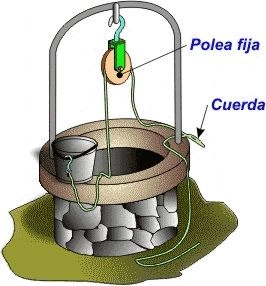
The most basic kind of pulleys are called fixed pulleys, and they are just wheels fastened to a fixed object, like a beam or ceiling.
They offer no mechanical advantage; instead, their main function is to reverse the direction of the force required to raise an object.
Furthermore, In flagpole systems, fixed pulleys are frequently used to facilitate the easy raising and lowering of the flag.
Fixed pulleys are used in theatrical shows for raising and lowering stage curtains, which adds a dramatic touch to performances, in addition to their use in flagpoles.
Movable Pulleys
The item being lifted has movable pulleys attached to it, which enable it to move with the load. Moreover, Moveable pulleys offer a mechanical advantage over stationary pulleys by sharing the weight between two parts of the rope or belt.
This facilitates the lighter and less forceful lifting of large objects. In compound pulley systems, movable pulleys are frequently utilized in conjunction with fixed pulleys to further boost the mechanical advantage.
They are frequently seen in weightlifting machines at the gym, where users can modify the resistance to suit their needs.

Compound Pulleys
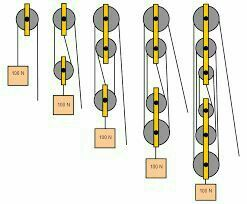
Compound pulleys yield an even higher mechanical benefit by combining both moveable and fixed pulleys. Moreover, these pulleys allow for the effortless lifting of very heavy loads by combining several pulleys into a single system.
These pulley systems are frequently used to raise and lower stage props in theatrical plays as well as to hoist things to higher floors of structures on construction sites.
Compound pulleys are used in industrial settings to safely and effectively raise heavy machines and equipment in addition to their use in entertainment and construction.
Advantages of Pulleys
| Advantage | Description |
|---|---|
| Mechanical Advantage | Pulleys provide a mechanical advantage by distributing the weight of a load across multiple ropes or belts, reducing the amount of force required to lift heavy objects. |
| Direction Change | Pulleys change the direction of the force needed to lift an object, allowing for versatile lifting capabilities in various directions, including upward, downward, or sideways. |
| Versatility | Pulleys are highly versatile and can be adapted for various tasks and applications, from simple lifting tasks to complex machinery, making them indispensable in many industries. |
| Safety | Pulleys enhance safety in lifting operations by reducing the risk of strain or injury associated with manual lifting, as they allow heavy objects to be lifted with minimal effort and strain on the user. |
Applications of Different Pulley Types
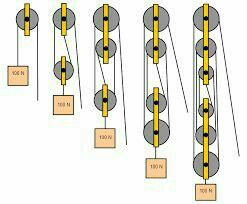
Fixed pulleys are utilized in workout equipment, stage rigging, and flagpole systems. They are also frequently used in agricultural environments, where they are used for jobs like moving buckets of water out of wells.
Moveable pulleys are a typical component of garage door systems, sailboat rigging, and weightlifting machines. They help rescuers hoist and descend victims from heights in a safe manner during rescue operations.
Compound pulleys are used to easily move huge things in theater shows, elevator systems, and construction cranes. They are also used in auto repair facilities to raise large parts, such as engines, for upkeep and repairs.
How Do Pulleys Work?
The mechanism by which pulleys, those small but mighty devices, function is through the application of mechanical advantage.
They basically consist of a wheel with a belt or rope that fits into a groove around the edge of the wheel. The wheel rotates when pressure is given to one end of the rope or belt, causing it to wrap around.
The pulley can raise the attached object thanks to this rotation. Because pulleys can distribute weight over several ropes or belts, lifting heavy objects requires less effort, which is why they are so beautiful.
They also provide adaptability in a range of applications by shifting the direction of the force required to lift the object.
By utilizing mechanical advantage, pulleys make tasks easier, whether you’re lifting weights in the gym or hoisting things at a construction site.
Where Are Pulleys Used
| Application | Description |
|---|---|
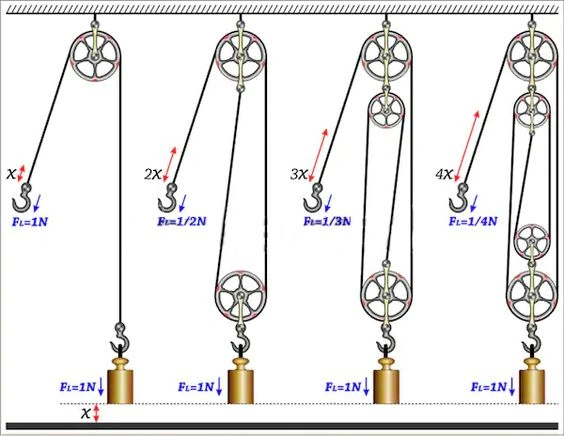
| Elevator Systems | Pulleys are integral components of elevator systems, facilitating the vertical movement of elevator cars between floors in buildings. |
| Construction Sites | Pulley systems are commonly used in construction for lifting heavy materials to upper levels of buildings or construction sites, improving efficiency and safety. |
| Flagpoles | Pulleys are employed in flagpole systems to raise and lower flags, allowing for easy display and maintenance of flags in various settings. |
| Exercise Machines | Many exercise machines, such as cable machines in gyms, incorporate pulleys to provide resistance and facilitate a wide range of exercises for fitness enthusiasts. |
| Sailboats | Pulleys play a crucial role in sailboat rigging, enabling sailors to adjust the position of sails and control the movement of the vessel with ease. |
| Stage Rigging | In theater productions and concert stages, pulleys are used for stage rigging, allowing for the smooth raising and lowering of set pieces, curtains, and lighting equipment. |
| Conveyor Systems | Conveyor systems in factories and warehouses utilize pulleys to move materials along the conveyor belt, facilitating the transportation of goods efficiently. |
| Garage Doors | Some garage door systems utilize pulleys to facilitate the opening and closing of garage doors, providing convenience and ease of operation for homeowners. |
| Rescue Operations | Pulleys are used in rescue operations to lift and lower individuals or equipment from heights safely, aiding in search and rescue efforts in various emergency situations. |
| Automotive Repair | In automotive repair shops, pulleys are utilized for lifting engines and other heavy components during maintenance and repair tasks, improving workflow and efficiency. |
Parts Of Pulleys
Magnificent mechanical devices, pulleys make lifting large objects easier by dividing the weight and shifting the force’s direction.
But what precisely is a pulley made of? We’ll examine each component of a pulley in this post, elucidating its different purposes inside this clever device.
Wheel
The wheel, a circular part with a groove along its edge, is the central component of every pulley. The rope or belt can travel smoothly when the pulley rotates by using this groove as a track to sit in.
Depending on the particular application and load requirements, the wheel’s size and composition can change; larger wheels are typically utilized for higher weights.
Axle
The rod or spindle that the wheel revolves around is called the axle. When force is given to the rope or belt, it stabilizes and supports the wheel, enabling it to rotate freely.
Usually constructed from sturdy materials like metal or high-strength plastic, the axle can withstand the stresses applied during lifting operations.
Groove
The rod or spindle that the wheel revolves around is called the axle. When force is given to the rope or belt, it stabilizes and supports the wheel, enabling it to rotate freely.
Usually constructed from sturdy materials like metal or high-strength plastic, the axle can withstand the stresses applied during lifting operations.
Rope or Belt
The device that transfers the user’s force to the thing being lifted is the rope or belt. It transfers the force applied by the user to the weight fastened to the opposite end by wrapping around the wheel’s groove.
For heavy lifting, pulley systems often use ropes, but belts may be preferred for decreased friction and smoother functioning.
Bearings
Balls are essential to the seamless functioning of a pulley even if they are not always visible. They minimize friction and enable the wheel to rotate with the least amount of resistance since they are situated where the axle and wheel meet.
Metal or ceramic bearings are available, and they are usually greased to provide smooth operation and increase the bearing’s lifespan.
Examples of Pulleys in a Table
| Application | Description |
|---|---|
| Elevator Systems | Pulleys are integral components in elevator systems, facilitating the vertical movement of elevator cars between floors in buildings. |
| Construction Sites | Pulley systems are commonly employed in construction to lift heavy materials to upper levels of buildings or construction sites, enhancing efficiency and safety. |
| Flagpoles | Pulleys are used in flagpole systems to raise and lower flags, allowing for easy display and maintenance of flags in various settings. |
| Exercise Machines | Many exercise machines, like cable machines in gyms, incorporate pulleys to provide resistance and enable a wide range of exercises for fitness enthusiasts. |
| Sailboats | Pulleys play a vital role in sailboat rigging, enabling sailors to adjust sail positions and control the movement of the vessel effectively. |
| Stage Rigging | In theater productions and concert stages, pulleys are utilized for stage rigging, facilitating the smooth raising and lowering of set pieces, curtains, and lighting equipment. |
| Conveyor Systems | Conveyor systems in factories and warehouses utilize pulleys to move materials along conveyor belts, streamlining the transportation of goods. |
| Garage Doors | Some garage door systems utilize pulleys to facilitate the opening and closing of garage doors, providing convenience and ease of operation for homeowners. |
| Rescue Operations | Pulleys are employed in rescue operations to lift and lower individuals or equipment from heights safely, aiding in search and rescue efforts in various emergency situations. |
| Automotive Repair | In automotive repair shops, pulleys are used for lifting engines and other heavy components during maintenance and repair tasks, enhancing workflow and efficiency. |
Conclusion
In conclusion, pulleys are ingenious mechanical devices that simplify lifting tasks by distributing weight and changing the direction of force, making them indispensable in various industries and everyday applications.
FAQs
To lift heavy objects by distributing weight and changing the direction of force.
Utilizes mechanical advantage to reduce the force needed to lift objects.
A simple machine consisting of a wheel with a groove around its edge and a rope or belt that fits into the groove.
Elevator systems use pulleys to lift and lower elevator cars between floors in buildings.
Related Posts:
Eddie Crazy Rich Asians As An Actor, Net Worth & Early life
Oswald In King Lear | Character Analysis & Quotes
Analysis Of First Player’s Speech In Hamlet | By Shakespeare