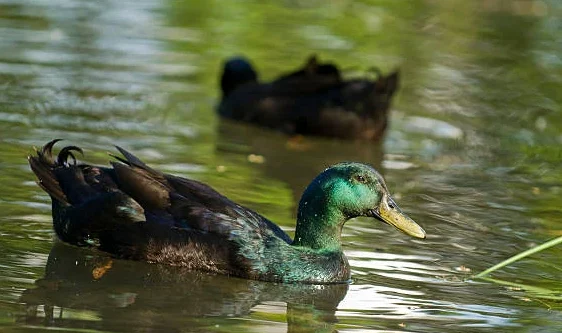
Michigan wetlands and lakes are frequented by a variety of Diving Ducks, including the colorful Wood Duck and the elegant Northern Pintail, providing birdwatchers and nature enthusiasts with a diverse and rewarding experience.

Wood Duck
The gorgeous iridescent plumage of the wood duck, which ranges in hue from red and yellow to green, purple, and white, is well-known. This species nests in cavities, frequently making use of fake nest boxes or repurposed woodpecker holes.
Wood ducks can be found in a range of wetland environments, such as beaver ponds, marshes, and swamps, due to their remarkable adaptability.

Mallard
Due to their remarkable adaptability, mallards can be found in a variety of settings, including secluded marshes and urban ponds. Furthermore, they are the forebears of numerous domestic duck varieties and are well-known for their characteristic “quack”.
Mallard ducks are dabbling ducks that mostly feed on the water’s surface by stooping forward to get at insects and aquatic vegetation.
Northern Pintail
Northern pintails, elegant and long-necked ducks with a characteristic silhouette, eat seeds, plants, and small invertebrates in shallow wetlands and marshes, where they are frequently seen.
Moreover, pintails are migratory birds that travel great distances between their breeding and wintering areas. In addition, they are distinguished by their high-pitched whistling sounds.

American Black Duck
With their mottled brown plumage, American black ducks resemble female mallards in appearance. Additionally, in eastern North America, black ducks are mostly found in brackish, shallow marshes.
They occasionally cross with mallard ducks, which gives them their characteristic “quack.”
Blue-winged Teal
The forewings of blue-winged teals, a small species of dabbling duck, have a noticeable sky-blue patch. Additionally, in marshes and shallow wetlands, they frequently eat insects, plants, and seeds..
Being highly migratory, blue-winged teals spend the winter in Central and South America after mating in North America.

Green-winged Teal
Having a green patch on their forewings instead of blue ones, green-winged teals are about the same size as blue-winged teals.
In addition, they can be found in lakes, ponds, and marshes, among other wetland habitats. Dabbling ducks, green-winged teals mostly feed on the water’s surface.
Canvasback
Large diving ducks with a reddish head and a characteristic sloping profile are called canvasbacks. Furthermore, they are native to North America and have a preference for huge open water features like lakes and bays.
With their ability to swim and dive well, canvasbacks consume aquatic vegetation, seeds, and invertebrates.
Redhead
Named for the beautiful reddish-brown head of the male, redheads are medium-sized diving ducks. In addition, they are native to North America and favor marshes and shallow wetlands. Being gregarious, redhead ducks frequently form huge flocks, particularly while migrating.

Ring-necked Duck
The name “ring-necked duck” refers to the medium-sized diving ducks that have a small ring around the neck of the male. Moreover, they are native to North America and favor lakes, ponds, and freshwater marshes. Skillful divers, ring-necked ducks eat aquatic vegetation, seeds, and crustaceans.
Greater Scaup
Medium- to large-sized diving ducks found in North America, Europe, and Asia are called greater scaups. Additionally, their bill is bluish-gray, and their head is rounded.
Large bodies of water are preferred by greater scaups, which also eat aquatic vegetation, seeds, and invertebrates.
Lesser Scaup
Though smaller and with a different head shape than bigger scaups, lesser scaups share a similar appearance.
Furthermore, they are native to North America and like marshes, ponds, and freshwater lakes. In addition, lesser scaups are fast divers that eat invertebrates and water plants.

Common Eider
Large sea ducks found in the northern hemisphere are called common eiders. Furthermore, they are distinguished by their soft down feathers, which they use to line their nests, and by their characteristic sloping forehead.
Moreover, common eiders use a wide range of marine invertebrates for food.
King Eider
The plumage of king eiders is more colorful and they are larger than common eiders. In addition, their deep, guttural sounds are well-known, and they can be found in the Arctic and subarctic.
King eiders are ideally suited to live in chilly, freezing seas and eat a wide range of marine invertebrates.
Harlequin Duck
These diminutive sea ducks are distinguished by their eye-catching plumage, which features prominent black and white patterns.
They are prevalent throughout Europe and North America, and they like swift-moving rivers and streams. Swift-moving swimmers, harlequin ducks consume a wide range of watery insects and invertebrates.

Surf Scoter
Large sea ducks found in North America are called surf scoters. They have a big, vibrant bill and a characteristic white patch on the back of their neck. Robust divers, surf scoters consume a wide range of marine invertebrates.
White-winged Scoter
Despite having white patches on their wings, white-winged scoters resemble surf scoters in appearance. They live in coastal waters and are found in North America. Robust divers, white-winged scoters consume a wide range of marine invertebrates.
Black Scoter
Native to Europe and North America, black scoters are sea ducks. Their entire plumage is black, and they have a characteristic yellow knob at the base of their bill. Furthermore, robust divers, black scoters consume a wide range of marine invertebrates.
Long-tailed Duck
North America and Europe are home to the medium-sized sea ducks called long-tailed ducks, or oldsquaws. In addition, they can be recognized by their long, pointed tail and melodic, high-pitched call.
Long-tailed ducks are suited to living in chilly, frigid environments and consume a wide range of marine invertebrates.
Gadwall
Native to North America and Europe, gadwalls are medium-sized dabbling ducks. Their plumage is mottled brown and gray, with a noticeable black spot on the back.
Shallow wetlands and marshes are common habitats for gaidwalls, which eat water insects and plants.
Northern Shoveler
Northern shovelers get their name from the big bills that resemble shovels and are used to filter food out of the water. They like shallow wetlands and are widespread throughout North America, Europe, and Asia.
Northern Fulmar
The medium- to big seabirds known as northern fulmars resemble gulls. Their bill features a unique tube-like structure that aids in the excretion of extra salt. The northern regions of the Atlantic and Pacific Oceans are home to northern fulmars.
Tufted Duck
Small diving ducks with a tuft of feathers on the back of their heads are known as tuftted ducks. Additionally, they are widespread in freshwater lakes and ponds and can be found in Europe, Asia, and North Africa.
Barrow’s Goldeneye
Named for the English nobleman and geographer Sir John Barrow, Barrow’s goldeneyes are medium-sized diving ducks. Moreover, they live in North America and favor lakes and ponds with trees surrounding them.

Common Goldeneye
Though they have a bigger white patch on their cheek, common goldeneyes resemble Barrow’s goldeneyes in appearance. They favor woodland lakes and ponds and are widespread throughout North America, Europe, and Asia.
Bufflehead
Small diving ducks with remarkable black and white plumage are called buffeheads. Moreover, On the back of their heads, the males have a sizable white patch. In addition, North American buffeheads are found in tiny ponds and marshes.
Hooded Merganser
Small diving ducks known as hooded mergansers get their name from the male’s characteristic black and white crest, which he may raise or lower. Although, they are native to North America and like ponds and forested wetlands.
Ruddy Duck
Ruddy ducks have blue beak and vivid chestnut bodies. They are small, robust diving ducks. Both North and South America are home to them.

Species Of Ducks In Michigan | ID, Calls, Season Guide
| Species | Identification Features | Calls | Season Guide |
|---|---|---|---|
| Mallard | Male has a glossy green head, female mottled brown | Male: “Quack” | Year-round, peaks in fall and spring |
| Wood Duck | Colorful plumage, iridescent green, red, yellow | High-pitched whistling | March to October |
| Northern Pintail | Long, slender neck, pointed tail feathers | Whistling “peep” | Fall and spring migration, some wintering |
| American Black Duck | Dark plumage, similar to female Mallard | Low, guttural quack | Year-round, more common in fall and winter |
| Blue-winged Teal | Male has sky-blue patch on wings, female mottled brown | High-pitched “peep” | Spring and fall migration, some wintering |
| Green-winged Teal | Similar to Blue-winged Teal, but with green patch on wing | Series of “quacking” sounds | Spring and fall migration, some wintering |
| Northern Shoveler | Large, shovel-shaped bill, blue patch on wing | Rapid “twittering” | Spring and fall migration, some wintering |
| Canvasback | Large diving duck, sloping profile, reddish head | Harsh “kraak” or “kra-ka-kraak” | Fall and spring migration, some wintering |
| Redhead | Red head, gray body, black chest | Nasal “kra-a-a” or “kra-a-ak” | Fall and spring migration, some wintering |
| Ring-necked Duck | Male has faint ring around neck, gray body | High-pitched “wit-wit” or “wee-oo” | Fall and spring migration, some wintering |
| Lesser Scaup | Small diving duck, bluish bill, white wing stripe | Low “quack” or “ga-ga-ga” | Fall and spring migration, some wintering |
| Gadwall | Mottled brown and gray plumage, black rear end patch | Soft, nasal “gag-ag-ag” | Fall and spring migration, some wintering |
Conclusion
In conclusion, Michigan’s wetlands and lakes serve as vital habitats for a diverse array of diving ducks, showcasing the region’s rich biodiversity and offering a unique opportunity for wildlife enthusiasts to observe these fascinating birds in their natural environment.
FAQs
The most common ducks in Michigan include Mallards, Wood Ducks, and American Black Ducks.
Diving ducks, such as Common Goldeneyes and Buffleheads, are known to eat fish in Michigan.
Yes, there are ducks in Lake Michigan, including various species such as Mallards, Canvasbacks, and Redheads.
Mallards are among the most common ducks in Michigan.
Related Posts:
Eddie Cheng In Crazy Rich Asians | Character Analysis
11 Important Themes Of Pygmalion & Symbolism| By Bernard Shaw
Lorenzo De Medici In The Price | De Medici (Biography, Net Worth)